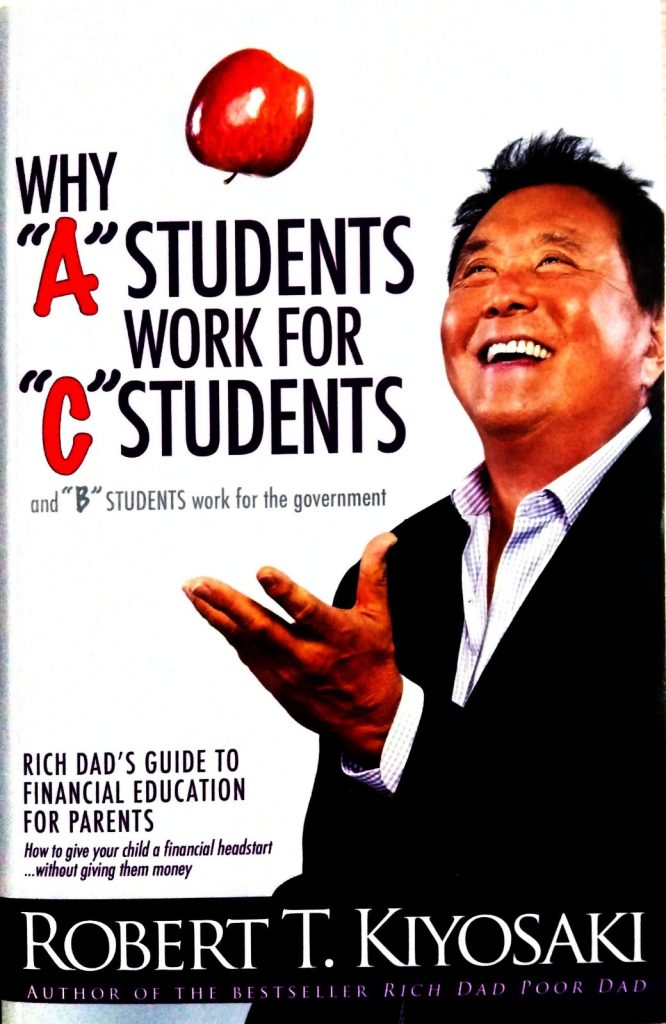
Summary
This book argues that traditional education is good at producing employees, but it often does not teach people how to build wealth, create businesses, or become financially independent. Kiyosaki(the author) believes that success in today’s world requires financial education, not just academic excellence.
Key lessons from the book
1. Schools teach academic skills, not financial skills
- Schools emphasize getting good grades and finding secure jobs.
- They rarely teach investing, entrepreneurship, taxes, or managing money.
2. “A” students often work for “C” students
- “A” students tend to become professionals (doctors, lawyers, engineers, accountants).
- Many eventually work for companies started by entrepreneurs who may not have excelled academically.
3. “B” students often work for the government
- Many average students pursue stable careers in government or public service, valuing job security and benefits.
4. Financial education is essential
Kiyosaki encourages learning about:
- Investing
- Starting and growing businesses
- Real estate
- Taxes
- Cash flow
- Building assets instead of liabilities
5. Encourage entrepreneurship
Parents should teach children:
- How money works.
- How to identify business opportunities.
- Leadership and problem-solving.
- How to create jobs instead of only seeking them.
6. Take calculated risks
The book argues that fear of failure prevents many people from achieving financial freedom. Learning from mistakes is presented as an important part of becoming successful.
Main message
Kiyosaki’s central idea is that financial intelligence is just as important as academic intelligence. He encourages parents and students to look beyond grades and develop skills that can lead to entrepreneurship, investing, and long-term wealth.
A balanced perspective
While the book has inspired many readers to think differently about money and entrepreneurship, its claims—such as “A students work for C students”—are broad generalizations rather than universal truths. In reality:
- Many top academic performers become successful entrepreneurs.
- Many entrepreneurs also have strong educational backgrounds.
- Success depends on a combination of skills, opportunity, persistence, and financial literacy, not grades alone.
Overall, the book is best read as an argument for expanding education to include financial literacy and entrepreneurial thinking, rather than as a literal rule about how people with different grades will end up in life.
What is your take home? Leave a comment